Team email deliverability: protect your sender reputation on a shared account
 Jean RubensUpdated July 202613 min read
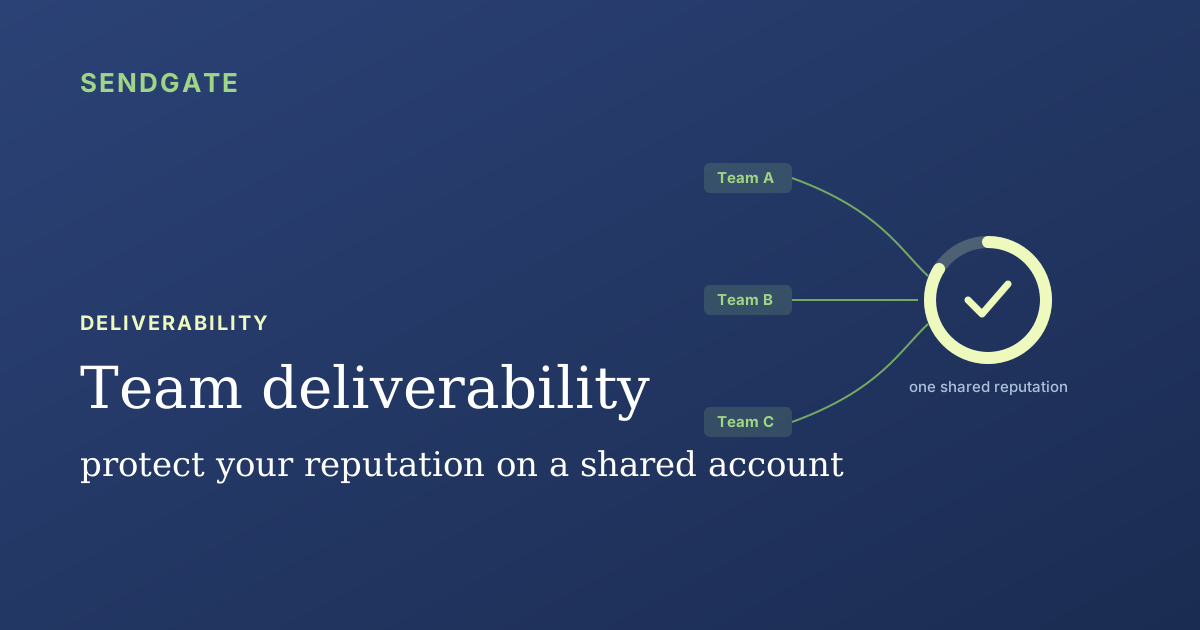
A shared account has one thing every team forgets it shares: a sender reputation. Every campaign is scored against the same domain, so one team's bad week costs all of you inbox placement. This guide covers what reputation is, why a shared account is uniquely exposed, and the moves that protect it, from authentication to frequency, without leaving Mailchimp.
Five teams log into one Mailchimp account. Each keeps a tidy dashboard and a clear conscience. Yet open rates are drifting down, and more mail is quietly landing in spam. No single campaign explains it, and no single team feels responsible. So what changed?
The shared sender reputation changed. It's the one asset every team draws from and pays into, and it doesn't appear on anyone's dashboard. Protecting it isn't mainly a technical job. It's a coordination job with a technical floor. This guide walks through both: the settings that keep you trusted, and the habits that keep five teams from spending that trust faster than any of them can rebuild it.
Key takeaways
- Roughly 15% of legitimate email never reaches the inbox, with global placement at 84.5% (Validity, Q2 2026). Reputation decides which side you land on.
- Google downgrades any sender above a 0.3% spam-complaint rate (Google, 2024), measured across the whole domain, not per team.
- Frequency is a deliverability input: over-frequency is the No. 1 reason people unsubscribe, cited by 43% (ZeroBounce, 2026).
- On a shared account reputation is common property, so protecting it is a coordination problem with a technical floor, not willpower.
What is sender reputation on a shared account?
Sender reputation is the trust score mailbox providers assign to your sending domain and IP, built from how recipients react to your mail. It decides placement, and the margin is thin: in 2026, about 15% of legitimate email never reaches the inbox, with global placement at 84.5% (Validity, \$42 Million a Day, Q2 2026). On a shared account, that score is collective.
A few inputs move that score: how often recipients open and reply, how many mark you as spam, how many addresses bounce, whether your mail is authenticated, and how steady your volume stays. Every team's sends feed all of those signals into the same domain. There's no per-team reputation to hide behind.
That's the mental shift a shared account demands. Your reputation isn't the average of five teams doing fine. It's the running verdict on the domain, and the worst-behaving stream pulls the hardest. Treat it as shared infrastructure, because that's exactly what it is.
Why is a shared account uniquely exposed?
Because reputation is domain-wide and additive, so risk pools where sending does. One sender pushing a spam-complaint rate above 0.30% can degrade inbox placement for every other sender and stream sharing that reputation (Suped, Shared IP pools and sender reputation, retrieved 2026). On a shared account, that "one sender" is often just one team having a rough month.
The teams usually aren't reckless. They're blind. Each meets its own internal rule and still, together, overwhelms shared contacts, because no rule spans every sender at once. We wrote a whole piece on the specific ways this plays out, in the 5 multi-team mistakes that wreck deliverability.
In the shared accounts we review, the damage almost never traces to one dramatic mistake. It's the slow sum: a bit of over-mailing here, a stale list there, an unauthenticated tool somewhere else. Each is survivable alone. Together, on one domain, they cross the line.
This is why we treat sending governance and deliverability as the same problem seen from two angles. If you want the access-and-frequency control side in depth, our complete guide to multi-team Mailchimp governance is the companion to this one.
How do SPF, DKIM and DMARC protect a shared domain?
They prove the mail really comes from you, and they're no longer optional. Since February 2024, Google and Yahoo require bulk senders to authenticate with SPF, DKIM and a published DMARC policy, or mail starts skipping the inbox (Google, Email Sender Guidelines, 2024). On a shared account, one properly authenticated domain gives every team a single strong identity instead of several weak ones.
Each record does one job. SPF lists which servers may send for your domain. DKIM signs each message so tampering shows. DMARC tells mailbox providers what to do when a message fails, and lets you see who's sending as you. Configure all three, once, for the shared domain.
The multi-team failure mode is fragmentation. One team plugs in a new tool with its own from-address, another sends from an unaligned subdomain, and suddenly part of your mail fails authentication while the rest passes. Decide the sending-identity strategy centrally, and route every team through authenticated domains.
Which metric decides inbox versus spam?
The spam-complaint rate, more than any other single number. Google downgrades any sender above 0.3%, and that rate is measured across your whole sending domain (Google, 2024). Aim to stay under 0.1% for a working margin. On a shared account, the rate you're judged on is the sum of every team's sends.
Here's the trap. Each Mailchimp report shows a team its own opens, clicks and unsubscribes. None shows the account's aggregate complaint rate against that 0.3% line. So the single number that can sink everyone is the one number nobody is assigned to watch, until placement drops and the investigation starts.
Complaints lag the send that caused them, and they pool at the domain level. By the time a team notices its own numbers dip, the domain has already been marked down for everyone. Watching the aggregate rate is the only early-warning system that works across teams.
Give the domain-level complaint rate one owner and a ceiling of 0.1%. When it climbs, that owner traces which send did it and adjusts before mailbox providers react. The multi-team mistakes guide covers the blind-metric problem in more detail.
How does list hygiene protect the shared reputation?
By keeping you off the signals that pull hardest: bounces and spam-trap hits. Email lists decay by roughly 28% a year as people change jobs and abandon addresses (ZeroBounce, Email List Decay, retrieved 2026). On a shared list, nobody owns cleanup, so every team keeps mailing the same aging contacts and feeding the domain the exact signals that lower placement.
Dead addresses don't just fail to convert. They hard-bounce, they hit recycled spam traps, and they produce the long silences that mailbox providers read as disinterest. Each one is a small deduction from a reputation five teams share. Multiply by a database no one prunes and the drift is steady.
Run a shared sunset policy: contacts who don't open or click for a set window, often around six months, stop receiving campaigns until they re-engage. It protects placement for every team at once, and it's far cheaper than rebuilding a burned domain reputation.
Hygiene and access are linked. When a stale "all contacts" export is one click away for any user, cleanup never keeps up. Scoping who can reach which lists, covered in can you restrict a Mailchimp user to specific audiences?, is half the hygiene battle.
Is frequency really a deliverability issue?
Yes, and it's one of the biggest. Over-frequency is the No. 1 reason people leave a list: in 2026, 43% named it as their main reason for unsubscribing (ZeroBounce, Email Statistics Report, 2025). Unsubscribes and complaints are reputation inputs, so additive cross-team frequency is a deliverability problem wearing a marketing hat.
The fix is a limit, not silence. A common working ceiling is 2 to 4 marketing emails per contact per month, tuned to engagement rather than applied as a blanket rule (Braze, What Is Frequency Capping?, 2025).
The shared-account catch is enforcement. A per-contact ceiling only works if someone can see the contact's total intake across every team and automation. Making that running total visible is the single highest-leverage move for protecting the domain, and it's the heart of the governance guide.
Shared IP, dedicated IP, and what about warm-up?
Most Mailchimp senders sit on a shared IP pool, where your reputation depends partly on your pool neighbors, and your own complaints can hurt theirs too (Suped, retrieved 2026). A dedicated IP isolates you from strangers, but it puts your reputation entirely on your own shoulders.
A dedicated IP isn't a free upgrade. It needs consistent, fairly high volume to stay warm, because mailbox providers distrust IPs that send in erratic bursts. Below that volume, a shared pool with a good provider usually delivers better than a cold dedicated IP would. Most multi-team accounts are better served fixing coordination than buying an IP.
Warm it up: start with your most engaged contacts and small volumes, then ramp gradually over several weeks so the IP builds a track record. Sending a large blast from a cold IP is the fastest way to land a new address in spam. Domain reputation still travels with you either way.
Whichever you use, the domain reputation is what most consistently follows your mail, so the coordination work in this guide matters more than the IP choice for almost every team sharing one account.
How do you protect deliverability on a shared account?
Set the technical floor once, then govern the shared reputation as one asset. The order matters: authenticate and clean first, because you can't out-coordinate a domain that fails DMARC or mails dead addresses. These six moves take a shared account from hope to something closer to a system, and they work on top of Mailchimp with no migration.
Authenticate one sending domain
Configure SPF, DKIM and DMARC once for the shared domain, and route every team and tool through it. No unaligned from-addresses.
This guide covers one tool in particular. For the wider frame and the definition of the category, see the email sending governance layer.
Compartmentalize lists by team
Give each team a defined space so a careless "select all" can't reach the whole base, and so hygiene has a clear owner per list.
Set one cross-team frequency ceiling
Agree a per-contact monthly maximum, and make each contact's real intake across every team visible so the ceiling actually holds.
Run a shared sunset policy
Stop mailing contacts who haven't engaged for a set window until they come back. It caps bounces and spam-trap hits for everyone.
Give the complaint rate one owner
Someone watches the domain-wide spam-complaint rate against a 0.1% ceiling and traces any spike to its source before providers react.
Keep consent and unsubscribes global
An opt-out must apply instantly across every team and list at once, not list by list. Compliance and deliverability pull the same way here.
The floor is technical; the rest is coordination that a shared account can't do on its own. Here's what Mailchimp covers natively and what needs a layer on top.
| Deliverability control | Mailchimp, natively | With a governance layer |
|---|---|---|
| SPF, DKIM, DMARC authentication | Yes: supported, you configure it | Same, plus one enforced sending identity |
| Single view of contact intake | No shared total across teams | Yes: running total per contact |
| Cross-team frequency ceiling | None: no per-contact cap at any tier | The real total per contact, tracked across teams and automations |
| Per-list access by team | No: the five roles apply account-wide | Yes: lists scoped per team |
| Domain-wide complaint-rate ownership | Per-team dashboards only | Yes: one aggregate view and owner |
Mailchimp plan capabilities change; verify against Mailchimp's help center before relying on a specific tier.
The shared-reputation visibility Mailchimp lacks, Sendgate adds it.
Sendgate sits on top of your existing Mailchimp account, with no migration. It compartmentalizes lists so each team only reaches its own contacts, centralizes where campaigns are composed, and shows the real send frequency per contact across every team before the next campaign goes out. You protect one shared reputation instead of hoping five teams protect it for you. Mailchimp is supported today.
Try it free →Email sending governance · Not affiliated with the brands mentioned
The takeaway
On a shared account, sender reputation is common property. Every team's sends are scored against the same domain, so placement rises or falls for all of you together, and the worst-behaving stream pulls the hardest.
Protecting it has a technical floor and a coordination layer:
- Authenticate one domain with SPF, DKIM and DMARC, and keep lists clean.
- Govern frequency and the complaint rate as single, domain-wide numbers.
- Compartmentalize access so no one reaches the whole base by accident.
- Give the shared reputation a single owner and a single view.
Do that, and the open-rate slides and spam scares that no one campaign explained mostly disappear, on the Mailchimp account you already have.
Frequently asked questions
What is a good sender reputation, in numbers?
Do SPF, DKIM and DMARC matter for a small team?
Shared IP or dedicated IP for a team on Mailchimp?
How does one team's sending affect everyone's deliverability?
How often should we email to protect deliverability?
Sources
- Validity, $42 Million a Day: The Real Cost of Election Season on Email (global inbox placement at 84.5% in Q2 2026), retrieved 2026-08-03. validity.com
- Google, Email Sender Guidelines, retrieved 2026-07-17. support.google.com
- ZeroBounce, Email statistics report 2026 (43% of unsubscribes tied to frequency, 1,091 respondents), retrieved 2026-08-03. zerobounce.net
- ZeroBounce, Email List Decay, retrieved 2026-07-17. zerobounce.net
- Braze, What Is Frequency Capping?, retrieved 2026-07-17. braze.com
- Suped, How shared IP pools and sending domains impact sender reputation, retrieved 2026-07-17. suped.com
- Litmus, Email Marketing ROI, retrieved 2026-07-17. litmus.com
Jean Rubens
Co-founder, Sendgate
Jean is a co-founder of Sendgate. He writes about multi-team email governance: sender reputation, send-frequency visibility and deliverability across shared sending accounts.