Brevo for teams: why your campaigns spiral out of control
 Jean RubensUpdated June 20269 min read
The word "free" in a subject line is rarely the problem. When five teams share one Brevo account, frequency becomes additive and nobody owns the inbox your contacts actually see. This piece breaks down why control slips and what it costs. For the full fix, it hands off to our complete governance guide.
Marketing sends a newsletter. Sales fires a sequence. The events team drops an invite. Each one looks reasonable on its own Brevo dashboard. Your contact gets all three in 48 hours, then quietly hits unsubscribe. Nobody did anything wrong, yet the result is a mess.
That's the multi-team paradox. Brevo is built for one coordinated sender, but you have several independent ones. No single person can see the total a contact actually receives, so the volume creeps up until people leave. Let's look at how it shows up, why it happens, and what it costs.
Key takeaways
- 43% of people unsubscribe because a sender emails too often, the No. 1 reason (ZeroBounce, 2026).
- The fatigue threshold often sits around 4-5 emails/week from a single sender; beyond it, complaints and unsubscribes accelerate.
- In shared accounts, a contact receives the sum of every team's "reasonable" volume, and no dashboard shows that total.
- The problem is a lack of visibility, so the fix has to be structural.
What does an "out of control" Brevo account look like?
The clearest symptom is an unsubscribe rate you can't pin on a single campaign. In 2026, 43% of people name excessive frequency as their main reason for leaving a list, ahead of every other cause (ZeroBounce, Email Statistics Report, 2025). When the cause is spread across teams, no one campaign looks guilty.
You probably know the signs. Two teams email the same segment the same morning. A prospect gets a nurture sequence and a newsletter on the same day. Someone exports "all active contacts" for a one-off blast. Each action is defensible on its own. The cumulative effect on the person receiving them is not.
In the multi-team Brevo accounts we've reviewed, the teams are rarely careless. They're blind. Each one meets its own frequency rule and still, together, overwhelms shared contacts, because no rule spans every sender at once.
Why do multi-team setups overwhelm contacts?
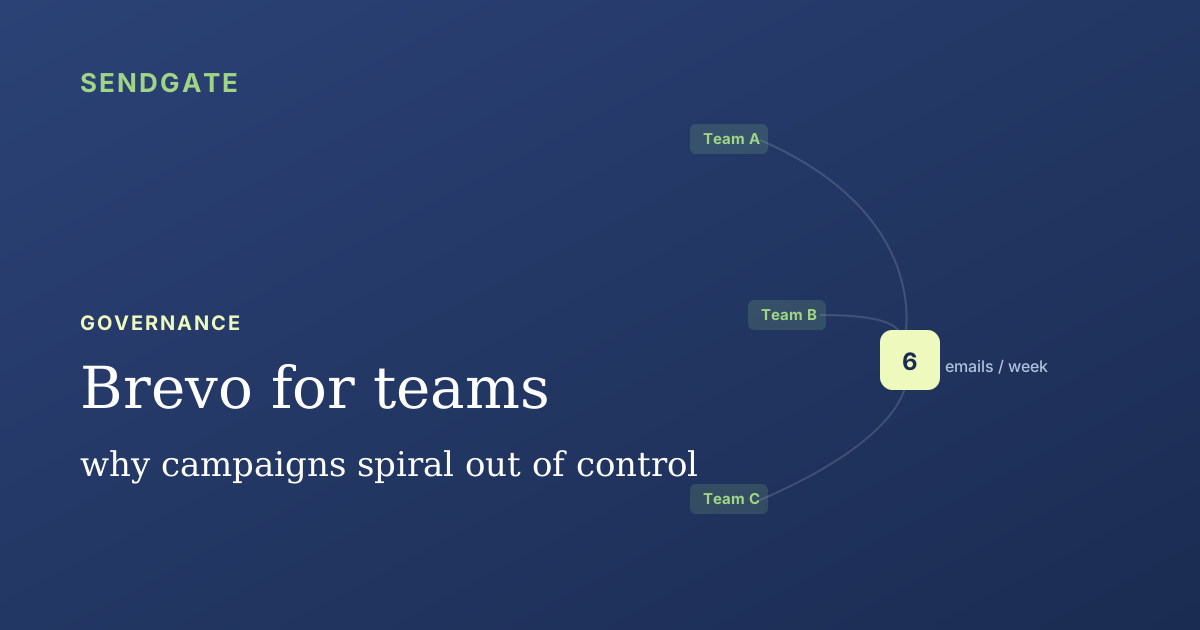
Because frequency is additive, but teams plan it in isolation. Three teams each sending twice a week feels modest internally. The contact experiences six emails, well past the fatigue threshold that's commonly cited around four to five per week from a single sender. Past that line, complaints climb and unsubscribes accelerate.
Here's the part dashboards hide. Every team measures its own output, never the contact's total intake. The dashboard says "2 emails this week." The person says "why won't this brand stop?" No amount of individual restraint closes that gap, because it's baked into the structure.
How big is the risk? The bet is asymmetric. One extra email earns almost nothing, but it can tip a contact toward the exit. Past a fatigue threshold often around four to five emails a week from a single sender, complaints climb and the list erodes, and over-frequency is the single biggest reason people unsubscribe.
What does over-emailing actually cost you?
It costs everyone deliverability, not just the over-mailed team. When overwhelmed contacts stop opening and start complaining, mailbox providers downgrade your whole sending domain. Since February 2024, Google's bulk-sender rules require spam-complaint rates below 0.3%, or mail starts skipping the inbox (Google, Email Sender Guidelines, 2024). One team's excess can sink every team's mail.
The baseline is already tight. In 2026, roughly 15% of legitimate email never reaches the inbox, with global inbox placement at 84.5% (Validity, $42 Million a Day, Q2 2026). Burn reputation with uncoordinated blasts and you eat into a margin that's thin to begin with.
The upside you're risking is real. Email still returns roughly $36 for every $1 spent, the highest of any channel (Litmus, Email Marketing ROI, 2024). Trading that reputation for one extra blast is a bad deal, and an avoidable one.
How do you start taking control back?
Start by making the contact's total visible, then decide what to do with it. You can't manage a volume you can't see, so visibility comes first. Three moves get you most of the way, and many teams settle on a self-imposed target of two to four marketing emails per contact per month, tuned to how each segment actually engages rather than applied as a blanket rule.
Compartmentalize lists by team
Give each team a defined space so a careless "select all" can't reach the whole database.
Create one shared view of intake
Someone, or some system, must see how often each contact actually hears from you, across every team, before the next send.
Centralize where campaigns are composed
Bring sends into one place so teams coordinate against the same picture instead of each working blind on its own dashboard.
Those three are the headline. The full method, including how to scope Brevo permissions and the exact setup order, lives in our complete guide to Brevo multi-team governance.
The visibility Brevo lacks, Sendgate adds it.
Sendgate sits on top of your existing Brevo account, with no migration. It compartmentalizes lists so each team only reaches its own contacts, centralizes composing in one place, and shows you who is touching which contacts. You finally see your real send frequency per contact, across every team, before the next campaign goes out.
Try it free →Email sending governance · Not affiliated with the brands mentioned
The takeaway
Multi-team Brevo accounts don't lose control because people are reckless. They lose it because frequency is additive and nobody can see the total. Each team plays by its own rules; the contact absorbs all of them at once.
The fix is structural: compartmentalize lists, give someone a single view of how often each contact really hears from you, and coordinate sends from one shared picture instead of separate dashboards. Do that, and the unsubscribe spikes and deliverability scares mostly fade.
Frequently asked questions
How many emails per week is too many?
Does Brevo have built-in frequency capping across teams?
Will reducing email frequency hurt revenue?
How does one team's over-emailing affect the others?
Sources
- ZeroBounce, Email statistics report 2026 (43% of unsubscribes tied to frequency, 1,091 respondents), retrieved 2026-08-03. zerobounce.net
- Validity, $42 Million a Day: The Real Cost of Election Season on Email (global inbox placement at 84.5% in Q2 2026), retrieved 2026-08-03. validity.com
- Google, Email Sender Guidelines, retrieved 2026-06-21. support.google.com
- Litmus, Email Marketing ROI, retrieved 2026-06-21. litmus.com
Jean Rubens
Co-founder, Sendgate
Jean is a co-founder of Sendgate. He writes about multi-team email governance: send visibility, list compartmentalization and compliance across shared sending accounts.