Lifecycle email: build a journey that retains, with guardrails
 Jean RubensUpdated July 202612 min read
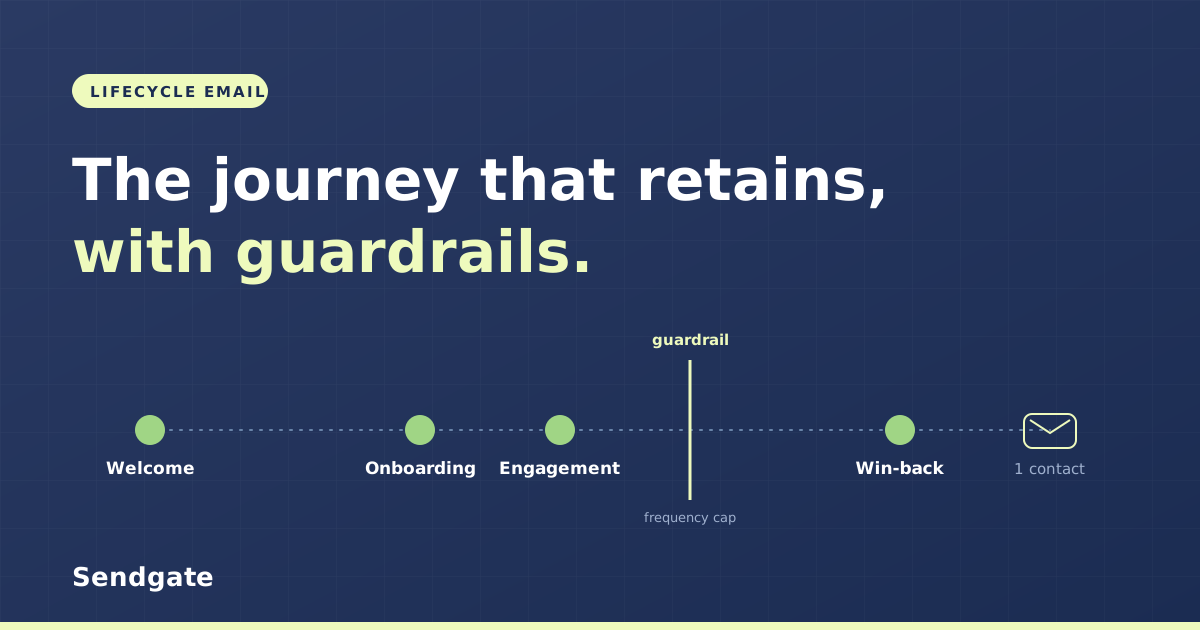
A lifecycle journey sends the right emails at the right moment in the customer lifecycle: welcome, onboarding, engagement, win-back. That's where most email revenue is made. But when several flows, and often several teams, run at once, they stack on the same contact and flood it without anyone seeing. This guide shows how to build the journey that retains, and which guardrails to set so it doesn't turn against you.
Someone signs up on Monday. They get a welcome email, fine. Tuesday, the onboarding series kicks off. Wednesday, the weekly newsletter goes to the whole base, and they're on it. Thursday, a re-engagement flow already reads them as "cooling" and nudges them. Friday, another team pushes a promotion. Five messages in five days, when each flow looked reasonable on its own.
No one decided to send five emails. The journey added them up. A well-built lifecycle program is the best retention lever you have; badly governed, it's also the fastest way to drive off the people you just won. The difference comes down to a few guardrails. Let's look at which ones, and how to build the journey around them.
Key takeaways
- Lifecycle carries the revenue: automated emails are 2% of sends but 30% of email revenue, about 16 times more per send than a scheduled campaign (Omnisend, 2025).
- The flip side is frequency: flows stack, and 43% of people unsubscribe because a sender emails too often (ZeroBounce, 2026).
- The key guardrail: a frequency cap across all flows, not flow by flow. A common starting point is 2 to 4 emails per contact per month (Braze, 2025).
- Deliverability is shared: over-sending drives complaints, which Google wants kept under 0.3%, and degrades placement for the whole account (Google, 2024).
What is a lifecycle email journey?
A lifecycle journey is a set of emails triggered by where the contact sits in their lifecycle, not by the calendar. New subscriber, active customer, silent contact: each state fires the right message. In 2025, these automated emails were just 2% of sends but generated 30% of email revenue, about 16 times more per send than a scheduled campaign (Omnisend, Email Marketing Statistics, 2025).
The reason is simple: a lifecycle email arrives when the contact is receptive, not when the marketing calendar decided. A campaign talks to everyone on the same day. A journey talks to each person at the right moment: at sign-up, after the first purchase, when engagement dips. That timing relevance is what explains the performance gap, and it's also what makes the journey dangerous when several flows fire on the same contact without coordinating.
What stages make up a journey that retains?
Four stages cover the essentials: welcome, onboarding, engagement, win-back. They aren't decorative: in 2025, three automation types alone, abandoned cart, welcome, and browse abandonment, concentrated 87% of orders from automated emails (Omnisend, Email Marketing Statistics, 2025). The journey isn't an add-on: it's where retention is won.
Each stage has a trigger, a goal, and, this is the part often forgotten, a guardrail of its own. Here's the reference map.
| Stage | Trigger | Goal | Its guardrail |
|---|---|---|---|
| Welcome | Sign-up | Confirm, set the tone, keep the promise | One entry point: don't let welcome and newsletter go the same day |
| Onboarding | First purchase or first use | Reach the first moment of value | Spread over several days, count it in the frequency budget |
| Engagement | Regular activity | Nurture the relationship, recommend | Yield priority to transactional and win-back flows |
| Win-back | Prolonged silence | Wake up, then decide | A short series, then suppression: don't nudge forever |
The four stages of a lifecycle journey and the guardrail each one needs.
Why does a lifecycle journey break without guardrails?
Because flows add up, but each is set in its own corner. Three flows sending twice a month each look modest on their own dashboard. The contact, though, gets six messages, not counting the newsletter and promotions. Over-frequency is the top reason people leave: in 2026, 43% named "too many emails" as their main reason for unsubscribing, ahead of every other cause (ZeroBounce, Email Statistics Report, 2025).
Here's what the dashboards hide. Each flow measures its own cadence, never the total the contact receives. The flow says "2 emails this month." The person says "why won't this brand stop?" No amount of flow-by-flow goodwill closes that gap, because the gap is structural: no one looks at the sum.
In the multi-team accounts we review, the journey is never careless. The problem is that each flow follows its own rule and no one sees the total the contact receives. Add up the welcome, the onboarding, the newsletter, and two nurture flows, and the shared contact ends up flooded, without any rule covering the whole. The guardrail is what makes that total visible and enforceable.
Which guardrails should you set on a lifecycle journey?
Four guardrails are enough to keep a journey healthy, and the first does most of the work. Set a per-contact frequency budget that holds for all flows at once: a common starting point is 2 to 4 marketing emails per contact per month, raised only if engagement stays strong rather than applied as a blind rule (Braze, What Is Frequency Capping?, 2025). That cap only works if it's shared: a per-flow cap protects nothing.
1. A frequency cap across all flows
This is the central guardrail. Decide the maximum number of messages a contact can receive over a period, then apply it to the sum of campaigns and automations, not to each flow in isolation. That view of the total is exactly what most accounts don't have.
2. Compartmentalized access by team and list
Keep each team within the lists it owns, so a flow launched by one team can't reach the whole base. Without that boundary, the best frequency rule collapses the moment someone picks the wrong audience. We break down the mechanics in the multi-team governance guide.
3. Global consent and unsubscribe
An opt-out should cut every flow at once, not list by list or scenario by scenario. A contact who unsubscribes from the newsletter but keeps getting three automations didn't do anything wrong: the journey is at fault, and it's a GDPR risk as much as a complaint risk.
4. Deliverability treated as a shared asset
One flow over-sending damages placement for every other. Since February 2024, Google's bulk sender rules require keeping the spam complaint rate under 0.3%, or mail starts landing in spam (Google, Email Sender Guidelines, 2024). And the margin is already thin: in 2025, roughly 15% of legitimate email never reaches the inbox, with global inbox placement at 84.5% (Validity, $42 Million a Day, Q2 2026). That's why we treat frequency as a deliverability lever.
A team switches on a frequency cap and assumes contacts are protected. Then the welcome series, the re-engagement flow, and three nurture automations keep firing, because on many ESPs automations are excluded from the cap by default. The flows most likely to cause fatigue are exactly the ones the cap doesn't cover out of the box. The dashboard number and the inbox number start to diverge again.
How do you build the journey, step by step?
Make the per-contact total visible first, then stack the flows on top. Order matters: you can't hold a limit you can't see. These six moves take a journey from "each flow hopes for the best" to "the rules hold on their own."
Map every flow that writes to the contact
List each campaign and each automation that can reach the same person, across all teams. The overlaps are where the flooding hides.
Set a shared frequency budget
Decide the maximum a contact should get per period, four a month is a reasonable start, and make it a shared rule that every flow respects.
Give the flows a priority
When two messages want to go in the same window, one yields. Transactional and win-back come before promotion: write that priority down, don't leave it to chance.
Compartmentalize access by team and list
Each team reaches only its own audiences. That's what stops a well-set flow from being bypassed by a careless "select all."
Create one view of what each contact receives
Someone, or a system, must see the running total a contact gets, campaigns and automations combined. That visibility is the control everything else depends on.
Close the journey with win-back, then suppression
A silent contact gets a short re-engagement series, then leaves the list if they don't respond. Emailing the inactive costs reputation for everyone.
Where does Mailchimp stop?
Mailchimp builds the flows well; what it doesn't do is treat the total a contact receives as one shared budget across every team and automation. There is no per-contact cap at all: the monthly send limit is an account-wide volume ceiling tied to your plan, and journey delays only space out steps inside a single flow. Content consistency weighs in too: production stays slow, with 62% of teams taking two weeks or more to produce and send a single email, largely lost in review back-and-forth (Litmus, State of Email, 2024). Here's the honest comparison.
| Journey guardrail | Mailchimp, natively | With a governance layer |
|---|---|---|
| Frequency cap across all flows | No per-contact cap, only an account volume ceiling | The real total per contact, tracked across every flow |
| One view of what each contact receives | No shared total | Yes: running total, campaigns and flows combined |
| Compartmentalized access by team and list | Feature-level permissions | Yes: access by list and by sender |
| Global, instant unsubscribe | Often manual, list by list | Yes: applies everywhere at once |
Plan capabilities change; figures verified against the Mailchimp help center in July 2026.
The guardrail your journey is missing, Sendgate adds it.
Sendgate sits on top of your existing Mailchimp account, no migration. You finally see the real frequency each contact receives, across every flow and every team, before the next email goes out. You compartmentalize access by team and keep a global unsubscribe. The journey retains, without flooding.
Try it free →Email sending governance · Not affiliated with the brands mentioned
What to remember
A lifecycle journey is the best retention lever you have: automated emails make 30% of revenue from 2% of sends. The risk isn't in any single flow, it's in their sum on one contact.
The discipline is structural:
- A shared frequency cap across all flows, not flow by flow.
- Compartmentalized access by team and list, so the rule doesn't collapse.
- Global consent and unsubscribe that cut everything at once.
- Deliverability treated as a shared asset, because one flow over-sending penalizes all the others.
Set these four guardrails and the journey does what it's built for: retain, without driving off the contacts you just won.
Frequently asked questions
How many emails should a lifecycle journey send?
Does the frequency cap apply to automated emails?
Should you delete inactive contacts or try to win them back?
Will sending less hurt revenue?
Does Mailchimp cap frequency across all flows?
Sources
- Omnisend, Email Marketing Statistics (2025 data), retrieved 2026-07-19. omnisend.com
- ZeroBounce, Email statistics report 2026 (43% of unsubscribes tied to frequency, 1,091 respondents), retrieved 2026-08-03. zerobounce.net
- Braze, What Is Frequency Capping?, retrieved 2026-07-19. braze.com
- Google, Email Sender Guidelines, retrieved 2026-07-19. support.google.com
- Validity, $42 Million a Day: The Real Cost of Election Season on Email (global inbox placement at 84.5% in Q2 2026), retrieved 2026-08-03. validity.com
- Litmus, State of Email, retrieved 2026-07-19. litmus.com
Jean Rubens
Co-founder, Sendgate
Jean is a co-founder of Sendgate. He writes about multi-team email governance: access compartmentalization, sending-frequency visibility, and compliance on shared sending accounts.